Dokter kandungan atau layanan kesehatan lingkungan dapat memberi saran skrining yang sesuai (misalnya pengukuran kadar timbal atau arsenik dalam darah/air kencing), rujukan ke spesialis toksikologi, serta langkah manajemen kehamilan yang diperlukan. Penting: deteksi dini dan konseling gizi/monitoring janin dapat mengurangi dampak jangka panjang.
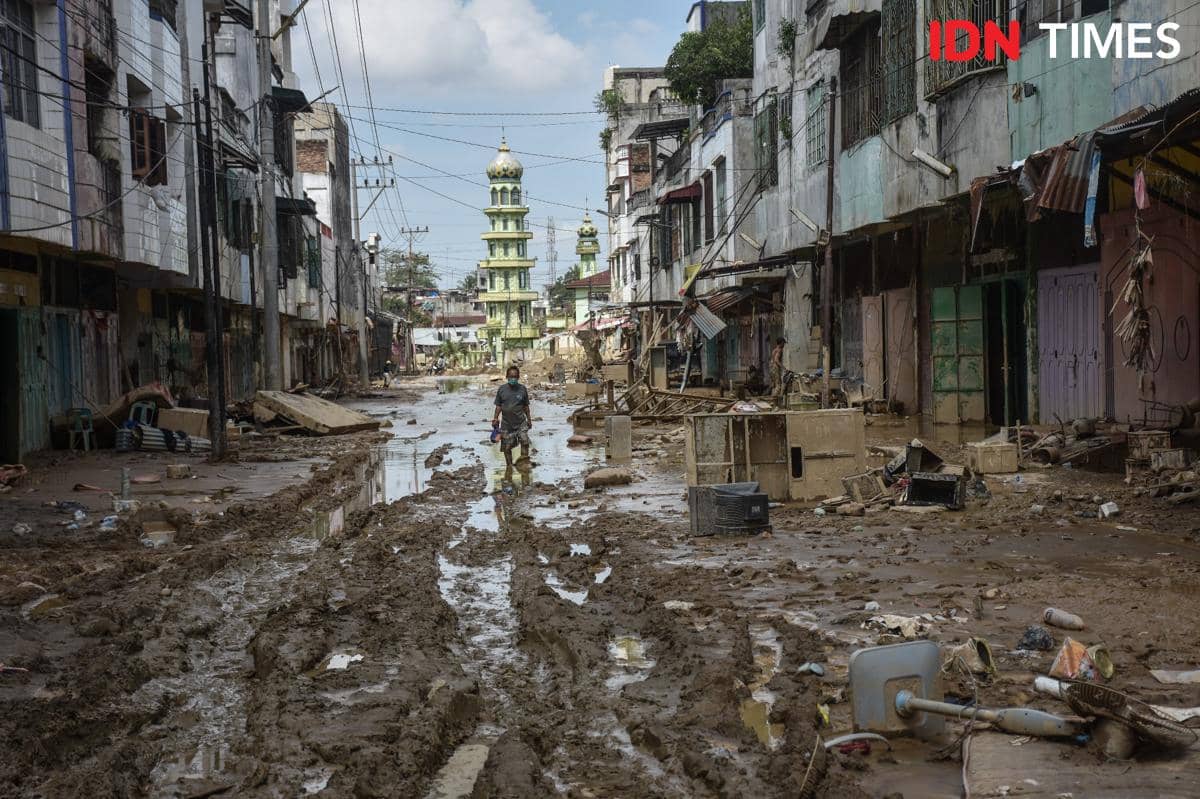
Banjir bisa menjadi mekanisme yang mengeluarkan dan menyebarkan polutan lama, termasuk logam berat. Untuk ibu hamil, potensi paparan ini ditemukan berhubungan dengan hasil kehamilan yang berisiko dan masalah perkembangan pada anak.
Langkah pencegahan yang rasional adalah kunci. Jika kamu sedang hamil dan mengalami paparan atau gejala mengkhawatirkan, segera cari nasihat medis untuk pemeriksaan dan tindakan yang tepat. Pengetahuan dan tindakan cepat membantu melindungi janin dan menurunkan risiko jangka panjang.
Dariusz Ciszewski and Tomáš Matys Grygar, “A Review of Flood-Related Storage and Remobilization of Heavy Metal Pollutants in River Systems,” Water Air & Soil Pollution 227, no. 7 (June 22, 2016): 239, https://doi.org/10.1007/s11270-016-2934-8.
Sabrina Shafi Zinia et al., “Effects of Heavy Metal Exposure During Pregnancy on Birth Outcomes,” Scientific Reports 13, no. 1 (November 3, 2023): 18990, https://doi.org/10.1038/s41598-023-46271-0.
Amber Hatter et al., “Heavy Metal Mobilization in Urban Stormwater Runoff From Residential, Commercial, and Industrial Zones,” Pollutants 5, no. 4 (September 30, 2025): 32, https://doi.org/10.3390/pollutants5040032.
"What’s behind the alarming rise in birth defects in Brazil’s illegal gold mining capital?" The Guardian. Diakses Desember 2025.
Yuan Ou, Jie Han, and Xiaoyan Gao, “Meta-analysis of Maternal Exposure to Heavy Metals (Lead, Cadmium, Mercury, Chromium) and Adverse Pregnancy Outcomes,” BMC Pregnancy and Childbirth, November 28, 2025, https://doi.org/10.1186/s12884-025-08507-x.
A. Kofi Amegah, Christian Sewor, and Jouni J. K. Jaakkola, “Cadmium Exposure and Risk of Adverse Pregnancy and Birth Outcomes: A Systematic Review and Dose–response Meta-analysis of Cohort and Cohort-based Case–control Studies,” Journal of Exposure Science & Environmental Epidemiology 31, no. 2 (January 29, 2021): 299–317, https://doi.org/10.1038/s41370-021-00289-6.
Reginald Quansah et al., “Association of Arsenic With Adverse Pregnancy Outcomes/Infant Mortality: A Systematic Review and Meta-Analysis,” Environmental Health Perspectives 123, no. 5 (January 27, 2015): 412–21, https://doi.org/10.1289/ehp.1307894.
Kyle Dack et al., “Prenatal Mercury Exposure and Neurodevelopment up to the Age of 5 Years: A Systematic Review,” International Journal of Environmental Research and Public Health 19, no. 4 (February 10, 2022): 1976, https://doi.org/10.3390/ijerph19041976.
Marcin Wróblewski et al., “The Impact of Arsenic, Cadmium, Lead, Mercury, and Thallium Exposure on the Cardiovascular System and Oxidative Mechanisms in Children,” Current Issues in Molecular Biology 47, no. 7 (June 25, 2025): 483, https://doi.org/10.3390/cimb47070483.
Anne E. Nigra et al., “Public Water Arsenic and Birth Outcomes in the Environmental Influences on Child Health Outcomes Cohort,” JAMA Network Open 8, no. 6 (June 16, 2025): e2514084, https://doi.org/10.1001/jamanetworkopen.2025.14084.